
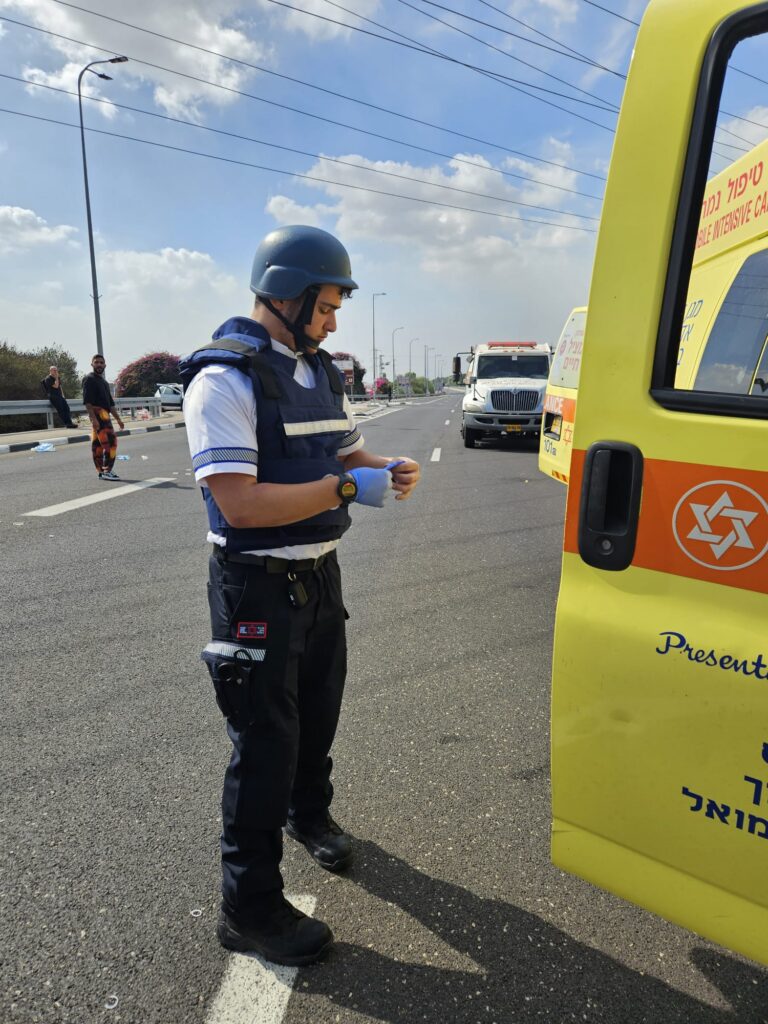
Itay Amar has been volunteering for MDA in Ashdod since he was 15. His sister, Shahar, began volunteering a year before him and “infected” him with the bug of love for MDA. Since then, he participated in all youth courses and training, striving for excellence, until he completed a paramedic course. It was a demanding, very high-level course that required investment,
seriousness, and ability, and he became a full-fledged paramedic.
On the morning of October 7, Itay was sleeping at his home in Ashdod near the MDA station; the night before, he had been immersed in reviewing the material he learned in the course. “When the sirens started, I checked at the station to see what was happening,” Itay recalls, “and they said that all youth volunteers were not allowed to join shifts for their safety, and therefore there was a need
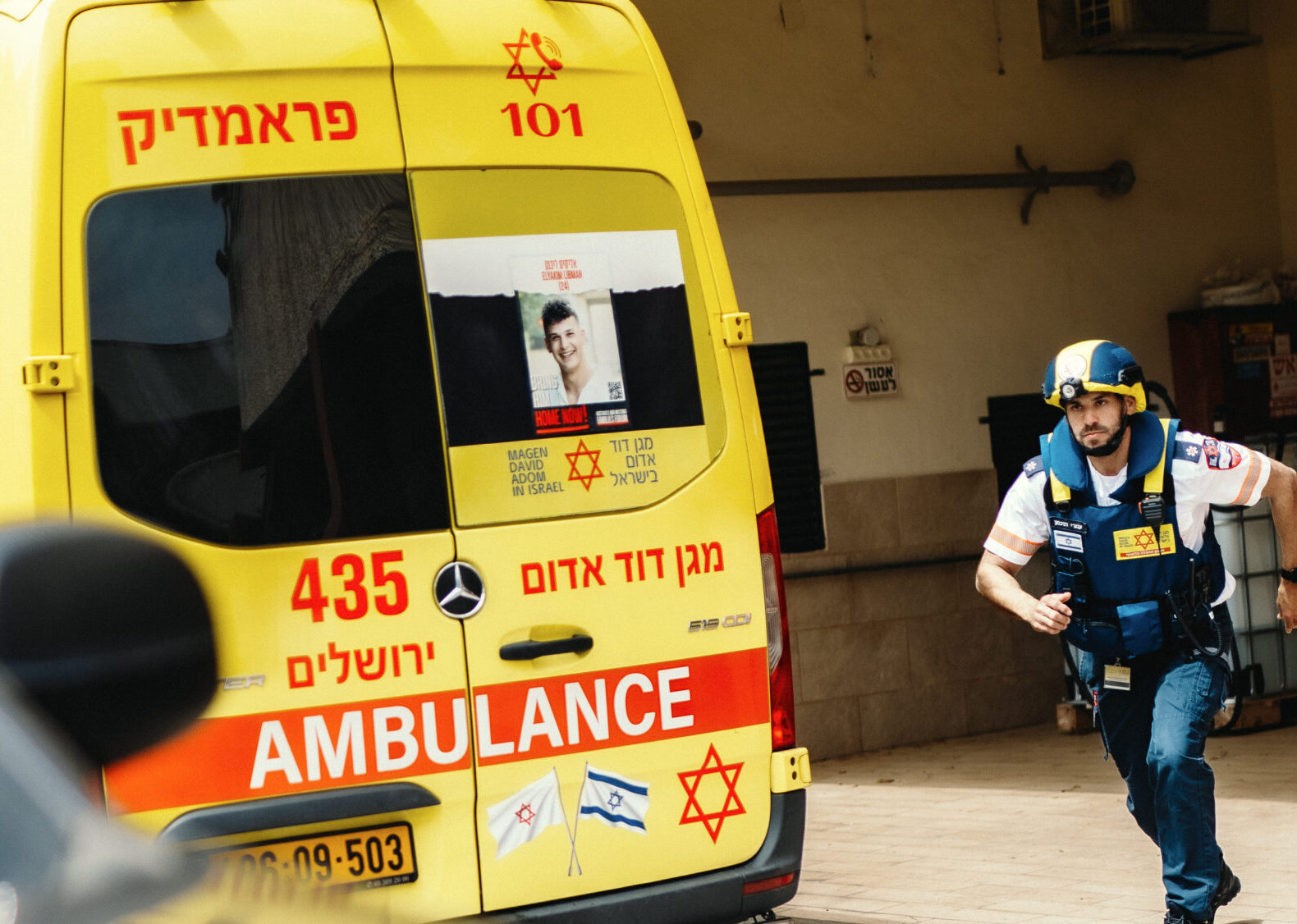
for adult volunteers to join the ambulances. During the sirens, I put on my uniform and ran to the station. I live a ten-minute walk from the station, but this time I made the trip in five minutes,” he says with a smile, “I arrived at the station before 7:00 AM, among the first.” Itay shared that the Deputy Regional Medical Manager,
paramedic Haim Levin, conducted a briefing for those present on the situation, which was still unclear, and a few moments later they set out in an ambulance toward the Gaza envelope. While driving, Itay wrote in the family WhatsApp group that he had been called up to reinforce the south, and he learned that his father, Chief Inspector Avi Amar, a senior officer in the Yoav unit of the Southern District
Police, had also been called up to reinforce the south. In Kochav Michael, the team joined paramedic Alisa Krant and began treating the many wounded brought from the battle zones by MDA’s bulletproof ambulances.
“The first casualty we treated was a police officer; he suffered from multi-system injuries from several gunshots. Alisa performed a complex procedure on him and essentially saved his life; afterward, we evacuated him to Barzilai Hospital.”
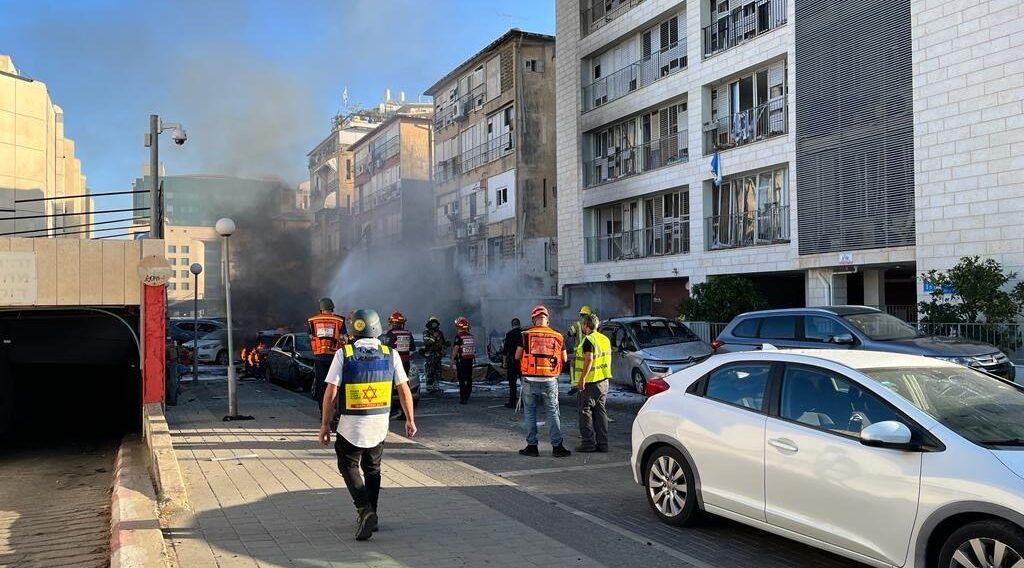
Afterward, the team was sent to the scene of a rocket strike in the city of Ashkelon. “It was a horrific scene,” Itay said, “to our right, fire and smoke due to a hit on a factory, and to our left, fire and smoke due to a hit on a field of thorns that ignited. The entire road was enveloped in thick black smoke. Terrible.”
Between one casualty and the next, in a true atmosphere of war, Itay corresponded occasionally with his father and checked on his well-being. When they returned to Kochav Michael, they noticed many MDA forces deployed there. “When we arrived the second time, there were already many ambulances that had arrived from all over the country, many MDA personnel. Dan Ben Yishai, our regional logistics manager, had already brought a lot of advanced equipment and ensured there was enough near every station.”
The team treated and evacuated more and more wounded and was even sent to shooting scenes in Moshav Geya, Kibbutz Bror Hayil, and more. At one point, they were sent to prepare for treating the wounded from Kibbutz Be’eri. They set up a casualty reception point, and then Itay heard a conversation between the paramedics that their friend, Amit Mann, may God avenge her blood, was besieged in Be’eri and treating the wounded there.
“I heard the concern in their voices,” Itay recalls, “We returned to Ashdod. I stayed for the night shift. My father stopped answering messages.” Itay continued to treat patients and hoped for the best, but every time they evacuated a casualty to the hospital, Itay looked for his father among the wounded brought to the emergency room. Only after a week did the bitter news arrive.
“I understand that during those hours he entered the heart of the danger. As I know my father, and also from what I heard from his acquaintances, he insisted on reaching the front and fighting inside the kibbutzim to save lives. In retrospect, I realized that while I was busy treating the wounded, my father was fighting terrorists in various arenas, until he finally fell in the battle for Kibbutz Be’eri. I am glad I still managed to write to him that I love him,” Itay said, “It’s not something taken for granted with us, two men, you know…”
Chief Inspector Avi Amar, of blessed memory, fought terrorists in the hardest battles, in Sderot, in Kfar Aza, until he fell in battle at Kibbutz Be’eri. His photo, kneeling and hugging a young soldier who broke down in the face of the difficult sights, just one hour before he fell, was published as a symbol of the courage and fellowship of that day. After his fall, he was posthumously promoted to the rank of Superintendent.
May his memory be a blessing.
Itay successfully completed the paramedic course and dreams of studying medicine alongside his continued volunteering at MDA. “I know my father is proud of me for the lives I saved that Saturday, and I am the proudest in the world of him for those he saved,” Itay said.
“After that day, I thought I understood what it means to be a paramedic and how important it is, but only after certification did I understand how many layers the paramedic profession encompasses. As a paramedic at MDA, I can find myself extricating a casualty from a vehicle, delivering a baby, managing resuscitation for a 50-year-old woman who collapsed in her home, and sitting down to have a conversation with
a lonely elderly person to connect them with social services, all in the same shift. Only when I was left with the full weight of responsibility as a telemedicine paramedic did I understand how much this profession is measured both in the big, dramatic moments and, all at once, in the simple moments—making a patient laugh who a moment ago felt
that their world was collapsing, holding the hand of an elderly patient during evacuation, being a listening ear and a supportive shoulder for every patient, whoever they may be. That day taught me how important our work is in cases where every minute is the difference between life and death; the work in the field taught me how these small, human moments
are just as essential. And throughout the journey, I feel my father’s hand on my shoulder, supporting, accompanying, and giving me strength every day, every shift, and with every patient; I am left only to continue making sure I make him proud.”
Later, Itay and MDA paramedic Alisa Krant had the opportunity to meet the first police officer they evacuated, who had been very seriously injured. The meeting was very significant for Itay:
“It mostly reminded me of the meaning of what we do. Seeing him after he returned home to his wife, his children, and his entire family reminded me of the significance of our activity in MDA. It’s an inconceivable feeling.”
Looking back on that day, Itay recalls a sentence from MDA paramedic Alisa that made him understand his mission:
“I was very impressed by MDA’s response to the terrible event of that Saturday. The forces that arrived from all over the country, the order—everyone knew their mission, the response was clear. I remember asking Alisa where we were going now and she answered: ‘Wherever they tell us to,’ everyone was ready, alert, prepared. It was impressive
and filled with pride,” Itay concluded.