




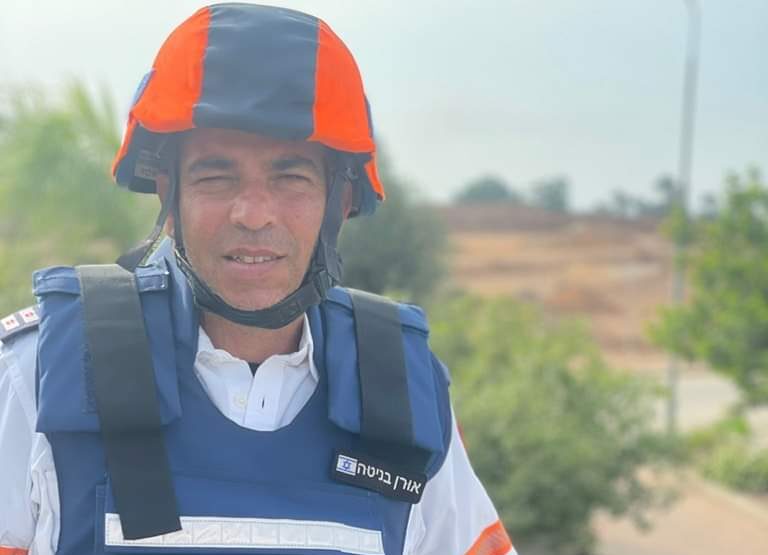
Oren Benita is a veteran Magen David Adom member and a highly regarded paramedic at the Sderot station. His wife, Meirav Benita, has been a shift supervisor at the Magen David Adom Lachish dispatch center for many years. Oren, Meirav, and their three children live in Kibbutz Mefalsim, located in the Gaza envelope.
On that Saturday, the Benita family was jolted awake early in the morning by the sound of a “Red Color” siren. “It was different than usual,” Oren recalls, “long and intense. Immediately afterward, sounds of gunfire were heard in the kibbutz along with a large explosion. Then I heard screaming outside, shouts for help, someone calling my
name. Two soldiers with gunshot wounds were brought into my home, into the living room. My wife Meirav and I began treating them right there in our living room.”
For a long time, Oren and Meirav treated the wounded using Magen David Adom medical equipment they had in their possession, as they serve as immediate response first responders for emergency calls near their location in their daily lives. However, the equipment was running low, and so was time. Oren understood what every Magen David Adom man and woman understands: the wounded must reach an operating room to survive.
However, the kibbutz was under siege. Terrorists were still on its grounds, there was constant gunfire, and it was impossible to leave or enter the kibbutz. “A battle zone,” Oren recalls, “a literal combat zone.” Magen David Adom paramedics are accustomed to difficult, life-altering decisions, but Oren had never faced a decision like this: if they went out to evacuate the wounded, their lives and the lives of the wounded
alike would be in danger. Not only might they fail to save them, but they might even become a burden on the military forces and their colleagues from Magen David Adom. A difficult decision.
At a certain point, Oren decided to evacuate the wounded to the entrance of the kibbutz, with the assistance and cover of their fellow fighters, and from there out of the danger zone using an armored Magen David Adom ambulance. Oren recalls the moments he witnessed the sights outside the house: “Difficult sights, many dead civilians lying there.” Only when he returned
to the kibbutz did Oren have a moment to think about his family members, who all this time were confined in the safe room, alone, because Mom and Dad were treating the wounded in the living room. The family was evacuated. Oren stayed.
“This work is what gives me the strength to keep going, again and again, despite everything. I got to see the soldiers we treated in our home walking on their own two feet — that makes it all worth it.”
The person who brought the wounded to Oren’s house with great resourcefulness is Magen David Adom volunteer Claudio Alberto Mairovich, then 26 years old, who also serves as the chairman of the local emergency response team (Tzahi) in the kibbutz. As early as 6:30 AM, Claudio was called up to operate the kibbutz command center. At first, he did not yet understand the scale of the event, but the sequence of sirens and the sounds of gunfire quickly made it clear to him
that the kibbutz was under a severe attack. The electricity was hit, and the residents were cut off from communication means precisely at the hour when they needed information and guidance most.
While Claudio and the kibbutz members worked to restore the command center systems to operation, wounded people began to arrive at the site. The first were two soldiers, members of the kibbutz, who suffered from gunshot wounds, with a tourniquet already placed on one of their legs. Claudio began providing them with life-saving medical treatment, but realized that due to the heavy
gunfire and the battles with the terrorists, it would not be possible to evacuate them quickly from the kibbutz. Therefore, he arranged for the two soldiers to be moved to the Benita family home, where, in the living room, Oren and his wife Meirav set up an improvised treatment site and continued to fight for their lives.
The uncertainty and the disconnection from what was happening outside the command center led Claudio to head out into the kibbutz wearing a Magen David Adom identification vest. Despite the ongoing gunfire, he tried to understand the situation and locate wounded people who were unable to reach treatment on their own. All the while, his family members were locked
in the safe room, and his son, a member of the standby squad, fought the terrorists and even survived an RPG missile fired at him. Toward noon, after control was gained over the kibbutz gate, Claudio went out once more to search for casualties, wearing his Magen David Adom vest.
Alongside nine deceased, he found a soldier who was seriously wounded. He provided him with life-saving medical treatment and assisted in transferring him to the ambulance that evacuated him to the hospital.