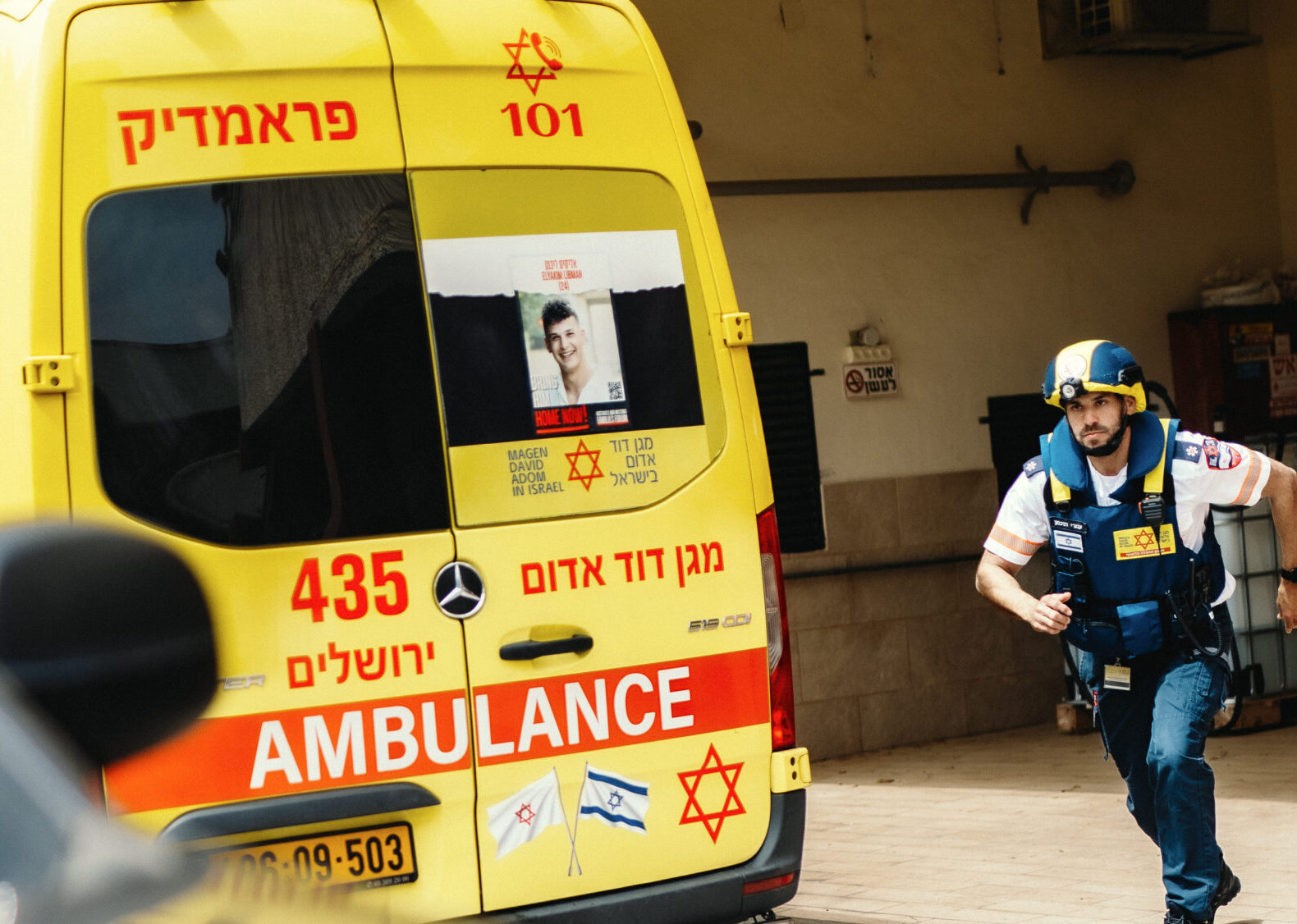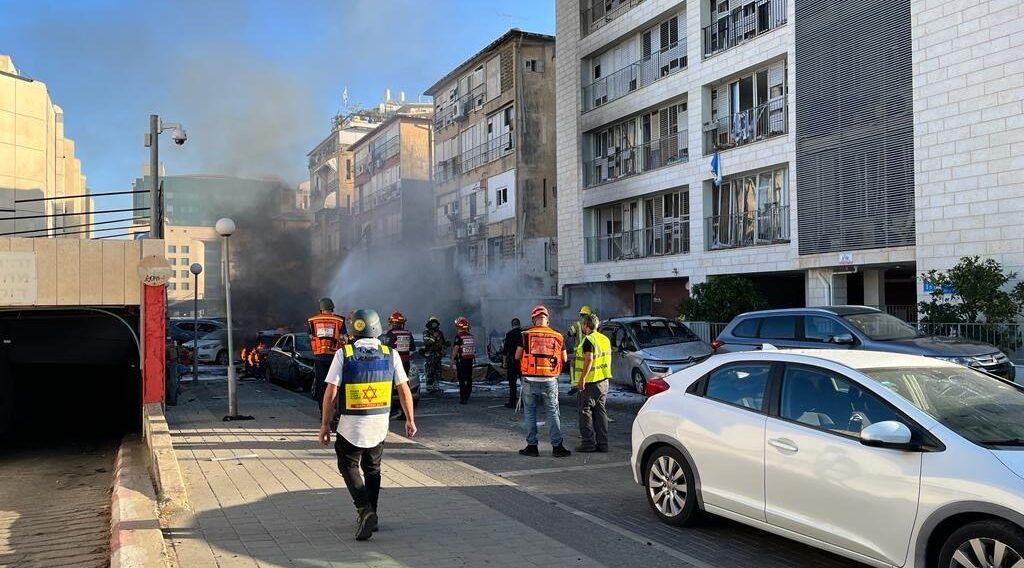
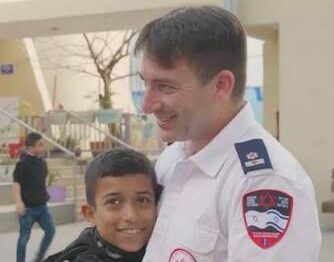
Zvi Tiber, a paramedic at the Magen David Adom station in Alfei Menashe, lives far from the Gaza Envelope, yet he also found himself treating and evacuating casualties under fire in southern Israel, as part of Magen David Adom’s response to the horrific events in the Gaza Envelope on October 7.
He woke up early on Saturday morning to the sound of sirens and explosions. He immediately contacted a Magen David Adom ambulance driver living in the settlement, and together they manned an intensive care unit ambulance on standby. The Magen David Adom cluster manager contacted them and requested that they go down to reinforce and provide assistance in southern Israel with a bulletproof ambulance. They prepared quickly and set off.
“I am a paramedic,” Zvi recounted, “Usually, when there’s an attack or shooting, within fifteen minutes there are no more casualties at the scene. We ‘clear them out.’ On the long drive south, we thought that by the time we arrived from Karnei Shomron to Ofakim, everything would be over… We didn’t know what was happening. No one yet knew the extent of the atrocities.”
On the way, the team was exposed to more and more scenes from the battlefield.
“The entire South was simply ablaze. Ofakim became a battlefield, and we treated the injured there,” he says. While treating the first casualty of that day, a police officer who was injured by gunfire, the team members began to realize that this was a larger event than they had imagined.
“He was the least severely injured casualty I had that day,” Zvi said, “He had two bullet holes. I took two personal bandages and applied pressure until the bleeding stopped. Along with him, a police officer suffering from anxiety came to me. Both of them, robust police officers, hugged each other, sobbed, and recounted desperate fighting with dozens of terrorists, and about fallen friends. They said they thought they wouldn’t make it out alive… I began to grasp what I had gotten myself into. We did several rounds like that, of rapid treatment and evacuation, and then I found myself treating civilians. I particularly remember a young woman from the ‘Nova’ music festival,” Zvi recalled.
“She and her partner were hiding in a bomb shelter; the terrorists threw grenades at them and set a fire at the entrance to the shelter. They inhaled smoke, were suffocating, and made an unthinkable decision to leave. On the way out, she stepped on the fire. The soles of her feet were scorched, and then they shot her; she had a gunshot wound to the thigh. We treated both of them and evacuated them to Soroka Hospital. On the way back, I wrote the medical report. That is, I wrote what I saw, what the circumstances were, and what treatment I provided. I remember saying to myself: ‘Is this a movie? I’m writing a script. Everything feels unreal.'”
Zvi and the team treated countless casualties in the battle for life, but there is one casualty he cannot get out of his head:
“I treated a five-year-old boy from Rahat; he was alone without any family member. He suffered from a very severe gunshot wound. He was pale, weak, and wouldn’t stop calling for his mother. As a father myself, it was very difficult for me to detach my emotions from the treatment. It turns out he was with his father who worked in the greenhouses. The terrorists shot
them at close range; the father was killed, but the uncle managed to smuggle him out of there. I fought for this child. A real battle for life. We evacuated him in critical condition. Since then, I constantly asked myself what happened to him. Not long ago, I read in the news that he is alive. I was so happy. I did everything I could; I wasn’t sure he would survive.”
The team treated many casualties in serious condition; Zvi remembers them all and describes the injuries and the treatment: